NYC Parking Violations:
Scalable ETL &
Analytics System
An end-to-end data pipeline that transforms 20GB+ of raw NYC parking violation records into an interactive dashboard designed to help city planners identify enforcement patterns, seasonal trends, and geographic hotspots.
Overview
New York City issues millions of parking violations each year. The data is publicly available but at over 20GB, it's not something you can simply download and explore. Raw records contain cryptic violation codes, inconsistent date formats, and no enrichment layer connecting a numeric code to what the driver actually did wrong.
This project built an end-to-end retrieval system to make that data usable: a pipeline that ingests from the NYC Open Data API, transforms and enriches it with PySpark, stores it in MongoDB, and serves it through an interactive Streamlit dashboard. The target user isn't a data engineer it's a city planner or policy analyst who needs to move from a question to an answer without writing a single line of code.
That framing shaped every design decision: what to clean, what to store, how to index, and what the dashboard surfaces by default. A system is only as useful as it is accessible to the people it's meant to serve.
Dashboard Demo
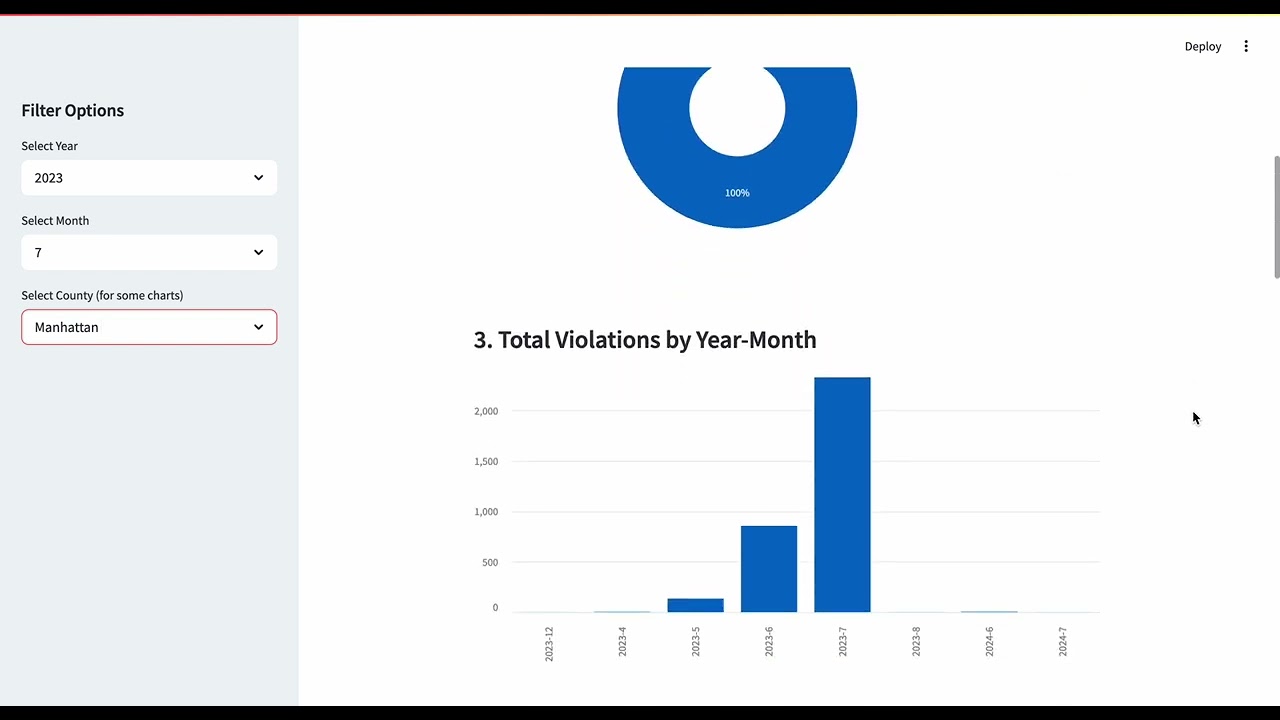
A live walkthrough of the Streamlit dashboard filtering by borough, month, and violation type to surface enforcement patterns across the city.
Business Problem
NYC's parking violation data is technically public but practically inaccessible at scale. The full dataset exceeds 20GB, making local processing impractical on most machines. Violation codes are numeric and meaningless without an external reference table. And without a structured query layer, answering even a simple question "which streets in Manhattan had the most violations last July?" requires hours of manual data wrangling.
How can we design a data pipeline that reliably processes millions of records and enables fast, interactive exploration of enforcement trends by time, location, and violation type?
The real problem wasn't storage or compute it was that no usable interface existed between the raw data and the people who needed to act on it. Municipal departments can't make evidence-based decisions about parking enforcement if getting to the evidence requires a data engineering project every time. This system was designed to close that gap permanently, not just answer one question once.
We also had to make a practical sampling decision: the full 20GB dataset exceeded local device limits, so we extracted a representative 1.1GB subset covering fiscal year 2023–2024. Key fields issue date, violation code, street code, vehicle type, and fine amount were spot-checked against the full population to validate that temporal and geographic patterns held in the subset.
ETL Pipeline
The pipeline follows four stages, each chosen for a specific reason rather than default tool selection.
One deliberate design choice: rather than imposing a rigid relational schema, we mirrored the API's output structure in MongoDB and layered aggregation at query time. This made the pipeline faster to iterate on and easier to extend to new fiscal years without schema migrations. The tradeoff slightly higher query complexity was acceptable given the read-heavy access pattern of the dashboard.
Stage 1 Extract: Paginated API Ingestion
The NYC Open Data API caps responses at 50,000 rows per request. A pagination loop accumulates up to 6 million records in batches, trimming to the exact target if it overshoots.
# Paginate NYC Open Data API to fetch up to 6M records
import requests, pandas as pd

target_rows = 6_000_000
limit = 50_000
offset = 0

url = f"https://data.cityofnewyork.us/resource/pvqr-7yc4.json?$limit={limit}&$offset={offset}"
violations_df = pd.DataFrame(requests.get(url).json())
offset += limit

while len(violations_df) < target_rows:
    next_url = f"https://data.cityofnewyork.us/resource/pvqr-7yc4.json?$limit={limit}&$offset={offset}"
    data = requests.get(next_url).json()
    if not data:
        break
    violations_df = pd.concat([violations_df, pd.DataFrame(data)], ignore_index=True)
    offset += limit

# Trim to exactly target_rows if we overshoot
violations_df = violations_df.iloc[:target_rows]
# → 6,000,000 rows fetched
Stage 2 Transform: PySpark Cleaning & Enrichment
PySpark handles date parsing, county code mapping, null treatment, and the join against an external violation code reference table turning numeric codes into human-readable descriptions and assigning the correct fine amount by borough.
from pyspark.sql.functions import col, to_date, year, month, upper, when, create_map, lit
from itertools import chain

# --- Clean & standardize ---
violations_spark_df = violations_spark_df \
    .withColumn("issue_date", to_date(col("issue_date"), "yyyy-MM-dd'T'HH:mm:ss.SSS")) \
    .withColumn("year",  year(col("issue_date"))) \
    .withColumn("month", month(col("issue_date"))) \
    .withColumn("street_name", upper(col("street_name"))) \
    .withColumn("violation_code", col("violation_code").cast("string"))

# Map county codes → readable borough names
county_map = create_map([lit(x) for x in chain(*{
    "NY": "Manhattan", "K": "Brooklyn", "Q": "Queens",
    "BX": "Bronx",    "R": "Staten Island"
}.items())])
violations_spark_df = violations_spark_df \
    .withColumn("county_name", county_map[col("violation_county")])

# --- Enrich: join violation code reference table ---
# Gives every record a plain-English description + fine amount
joined_df = violations_spark_df.join(violation_codes_spark_df, on="violation_code", how="left")

# Fine amount differs by borough; assign correct value per row
joined_df = joined_df.withColumn(
    "fine_amount",
    when(col("county_name") == "Manhattan", col("fine_amount_manhattan"))
    .otherwise(col("fine_amount_other"))
).drop("fine_amount_manhattan", "fine_amount_other", "violation_county")
Stage 3 Load: Write to MongoDB
The cleaned, enriched DataFrame is written to MongoDB via the Spark–Mongo connector. Pre-aggregated collections for each chart type are written separately so the dashboard queries pre-computed results rather than scanning the full collection at runtime.
# Write final dataset to MongoDB
final_df.write \
    .format("mongo") \
    .mode("overwrite") \
    .option("database", "nyc_parking_violations") \
    .option("collection", "parking_tickets") \
    .save()

# Pre-aggregate violation counts by type for faster dashboard queries
violation_type_agg = final_df \
    .filter((col("year") == 2023) | (col("year") == 2024)) \
    .groupBy("violation_code", "violation_description") \
    .count() \
    .toPandas()

spark.createDataFrame(violation_type_agg).write \
    .format("mongo") \
    .mode("overwrite") \
    .option("database", "nyc_parking_violations") \
    .option("collection", "violation_types_2024") \
    .save()
Stage 4 Visualize: Streamlit Dashboard
The dashboard reads from MongoDB and re-filters in memory. Sidebar controls for year, month, and county drive all seven charts simultaneously without page reloads.
import pandas as pd
import streamlit as st

df = pd.read_csv("finalpark.csv")
df["issue_date"] = pd.to_datetime(df["issue_date"], errors="coerce")
df["year"]  = df["issue_date"].dt.year
df["month"] = df["issue_date"].dt.month
df = df[df["year"].isin([2023, 2024])]

# Sidebar filters
selected_year   = st.sidebar.selectbox("Year",   sorted(df["year"].unique()))
selected_month  = st.sidebar.selectbox("Month",  sorted(df["month"].unique()))
selected_county = st.sidebar.selectbox("County", ["All"] + sorted(df["county_name"].dropna().unique()))

filtered = df[(df["year"] == selected_year) & (df["month"] == selected_month)]
if selected_county != "All":
    filtered = filtered[filtered["county_name"] == selected_county]

st.title("🚓 NYC Parking Violations Dashboard (2023–2024)")

# Chart 1 violations by type
st.markdown("### Violations by Type")
st.bar_chart(filtered["violation_description"].value_counts().head(10))

# Chart 2 borough distribution
st.markdown("### Borough Distribution")
county_dist = filtered["county_name"].value_counts()
st.plotly_chart({"data": [{"labels": county_dist.index, "values": county_dist.values,
                             "type": "pie", "hole": 0.4}]})
Key Insights
The system was validated through exploratory testing across different time and borough slices. Several consistent patterns emerged that would be difficult to surface from raw data alone.
Violation volumes peak mid-year across most boroughs, suggesting enforcement activity tracks weather, tourism, and seasonal street use rather than being uniformly distributed. This has implications for staffing and enforcement resource allocation.
Manhattan accounts for a disproportionately large share of total violations relative to other boroughs a concentration that holds consistently across violation types and time periods, pointing to density and commercial activity as drivers.
A small subset of violation types predominantly no-standing and meter violations drives the majority of total fine revenue. Enforcement outcomes are highly concentrated, which matters for both revenue forecasting and targeted policy interventions.
AWS cost model for full 32GB deployment: ~$767/month across MongoDB Atlas, Apache Spark, and Streamlit hosting. Each component scales independently, meaning the system can grow to full dataset coverage without architectural changes.
These findings weren't the end goal the system that made them discoverable was. A static report shows the same numbers once. This pipeline lets an analyst ask a different question tomorrow without waiting for a data team to run it.
Takeaways
Schema design is a strategic decision, not a default. Choosing MongoDB over a relational database was about matching storage structure to the actual query patterns the end user needs not about what tool the team was most familiar with.
The bottleneck in large-scale public datasets is rarely the data itself it's the absence of a usable interface. The ETL pipeline's value was in creating that interface, not in the transformation steps alone.
The violation code join was a small technical step with outsized impact. Without it, the dashboard would have shown numbers no analyst could interpret. Data enrichment decisions determine whether a system is actually usable by its intended audience.
Designing for a non-technical end user from the start changed what we built. If the goal had been to impress engineers, the architecture would have looked different. Starting with "who needs to use this and what do they need to know?" produced a better system.
The natural next step would be real-time ingestion and integration with NYPD or NYCDOT operational data moving from historical pattern analysis to live enforcement signal detection that could actually inform day-to-day decisions.